Discover the foundations, attitudes and methods of a living model of change.
What is Process Work?
„The disturbance is not an obstacle to the process; the disturbance is the process.“ (A. Mindell)
Process Work according to Arnold Mindell is an awareness-based, process-oriented, holistic model for understanding and facilitating change. Also known as Process-Oriented Psychology. It assumes that thoughts, feelings, conflicts and body experiences are expressions of a deeper process that wants to unfold. Instead of solving problems too quickly, attention turns to what is showing up right now – even if it is irritating, contradictory or unfamiliar. It is precisely in these moments that hints of new, previously unlived possibilities often lie.
What does process-oriented mean?
Working in a process-oriented way does not follow a preconceived idea or method, but what is actually happening in the moment.
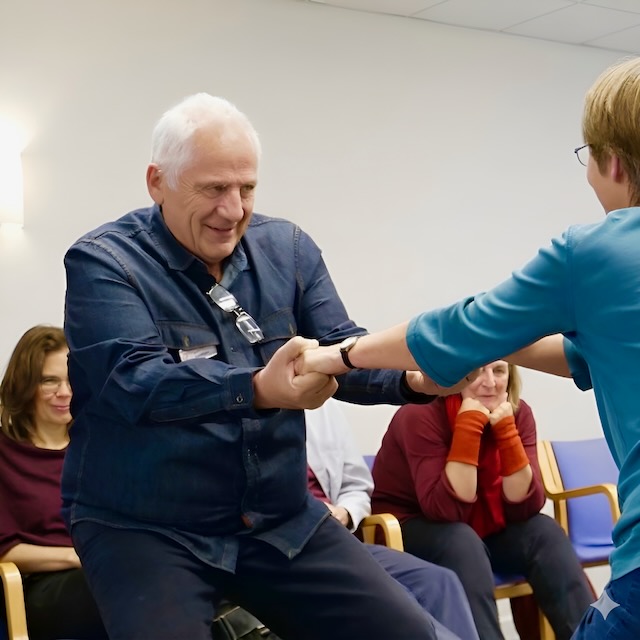
Special attention is paid to verbal and non-verbal signals: body language, moods and subtle changes in contact. They indicate where a process wants to go. We stay in contact with the other person and consciously follow the unfolding event without interpreting or intervening.
Deep Democracy
Deep Democracy is a central paradigm of Process Work and a fundamental principle of diversity. It combines psychological, social and political perspectives and is both an attitude and a method.
All viewpoints and experiences are included in the process: the loud and the quiet, the majority views and the uncomfortable ones, as well as our own inner reactions and contradictions.
Tensions and polarisations are not understood as disturbances but as potential for development that wants to be consciously perceived and integrated. This creates awareness of power dynamics, privilege and exclusion, and of the diversity in every system. When marginalised voices in particular are given space, the dynamics in the field become visible and change can emerge from within.
Levels of experience
Human experiences do not arise in isolation but in the interplay of different aspects of perception and experience:
Individual – the inner world: feelings, dreams, inner parts (such as the inner critic & child), body experiences
Relationship – interactions with others: patterns of behaviour, rank, connection
Group – dynamics in teams and communities: hierarchies, rank and roles
Society and world – collective themes, values and moods
Environment and field – our connection to nature, places and our living space
Much like a painting that only reveals its motif through countless brushstrokes: layer upon layer of paint creates shapes, depth and meaning. Change is therefore never one-dimensional, but the expression of a living, interconnected whole.
Worldwork
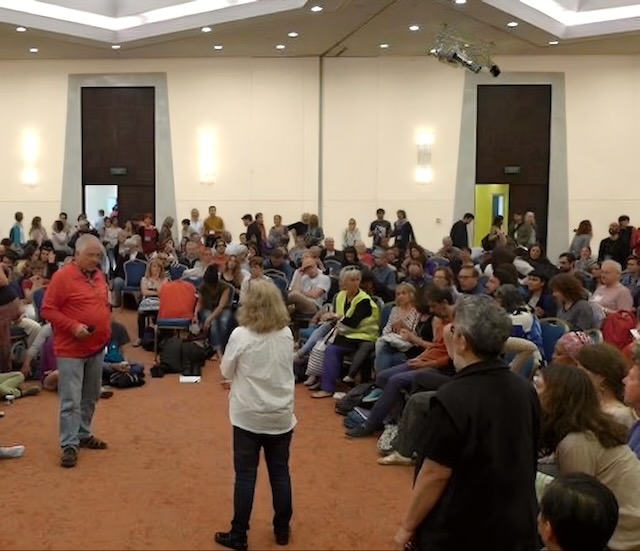
Worldwork applies the principles of Process Work to groups, communities and areas of social tension. It creates spaces in which contradictory perspectives and differences in power become visible and can relate to one another.
At its centre is the question of how we can deal with polarisation, diversity and collective challenges in a way that makes development and respectful coexistence possible. External events and inner experiences are included equally.
This creates a deeper understanding of the dynamics in the field and new possibilities for dialogue and joint action.
Amplification instead of interpretation
At the heart of Process Work is a simple but fundamental attitude: we do not interpret too quickly – we perceive, amplify and bring into awareness.
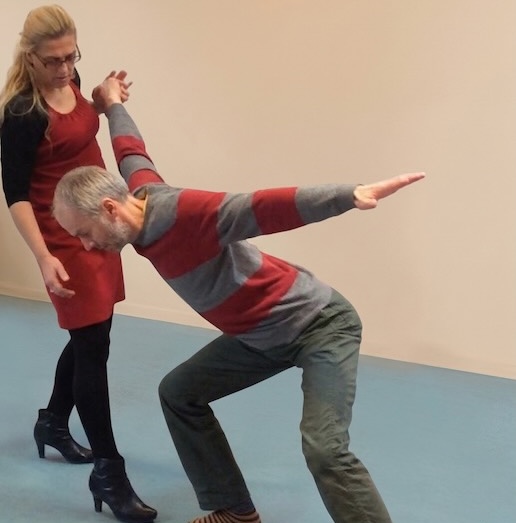
Small signals, minimal movements, facial expressions and gestures, changes in the voice or the atmosphere are observed mindfully and deliberately amplified. This makes visible what was previously only at the edge of awareness.
Instead of setting a direction, we orient ourselves by the other person’s feedback. The process can unfold organically and new insights arise from the experience itself.
Facilitation instead of moderation
Facilitation means enabling and supporting processes instead of prescribing solutions. It is about creating a space in which even complex dynamics may unfold – quite unlike classic moderation, which is fixated on quick results.
Inner tensions, resistance or different needs are consciously included. At the same time, the work remains goal-oriented: By following the process, solutions emerge that are supported by all sides.
Facilitation moves in the tension between set goals and what is at work in the background. It strengthens the ability of everyone involved to reorganise themselves.
Arnold Mindell
Arnold Mindell (1940–2024) was a physicist, therapist and the founder of Process Work (Process-Oriented Psychology). Starting from Jungian psychology and quantum physics, he developed a model that combines insights from psychology, systems and communication theory with social questions and the knowledge of indigenous cultures and philosophical traditions.
His work grew out of a fundamental curiosity: he wanted to understand how meaning shows itself in unusual experiences and how these are connected. He researched in direct contact with people, bringing a humorous and often surprisingly direct manner. His scientific and at the same time deeply human attitude remains the core of Process Work today.
Books about Process Work
If you want to dive deeper into Process Work, here you will find selected books and recommendations by Arnold Mindell and other process workers.
"Process Work is the awareness of the moving ground, of the flow of events around and within us … (it) adheres to no personality theory because the entire focus is upon awareness.“ (A. Mindell)